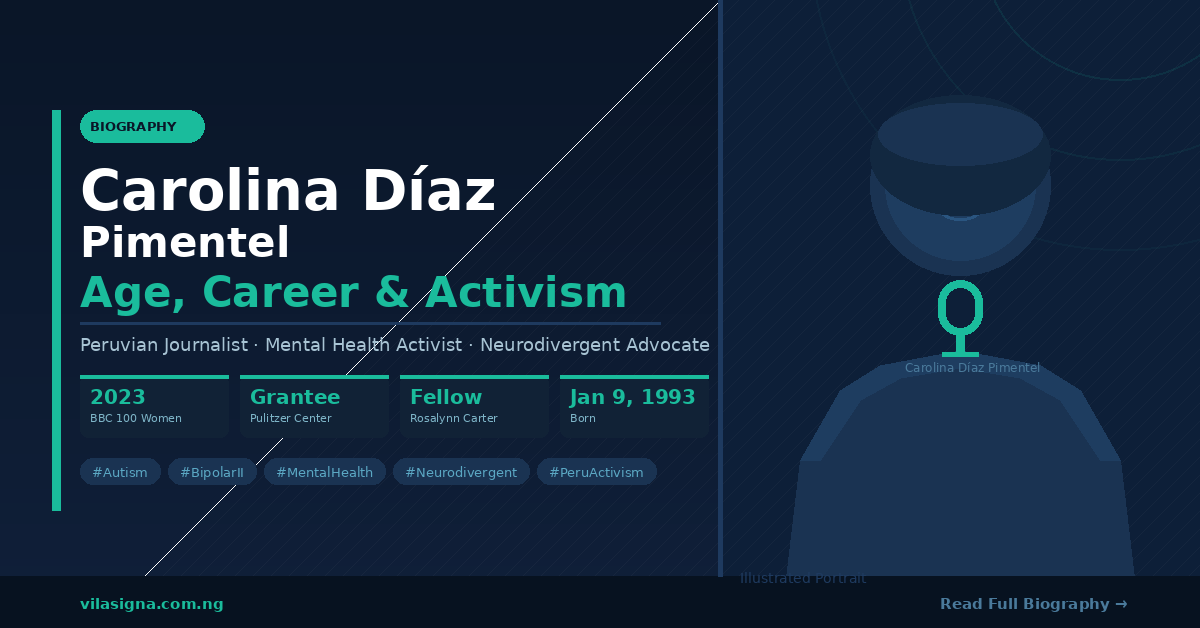
There’s a woman in Lima, Peru who carries red and green tape in her backpack to mark off a quiet corner of a park — a corner where nobody has to make eye contact, nobody has to stay on time, and nobody has to explain why they need to leave early. That woman is Carolina Díaz Pimentel, and she’s doing something that most institutions with far more money and influence have failed to do: she’s making neurodivergent people feel like they actually belong in the world.
Carolina isn’t just a mental health journalist. She’s a diagnosed autistic woman, a bipolar II advocate, a coalition founder, a Pulitzer Center grantee, and — since November 2023 — one of the BBC’s 100 most influential women in the world. But more than any of those titles, she’s proof that telling your own story out loud, even when it’s scary, can reshape an entire conversation.
Table of Contents
Who Is Carolina Díaz Pimentel?
Early Life and Education in Peru
Carolina Díaz Pimentel was born on January 9, 1993, in Lima, Peru. She pursued higher education at the Peruvian University of Applied Sciences (UPC), one of the country’s leading private universities. From early on, she was drawn to communication — to the idea that words could do more than describe the world, they could change how people experience it.
Peru, like much of Latin America, has a complicated relationship with mental health. It’s a topic often met with silence, religious dismissal, or outright shame. Growing up in that environment, Carolina didn’t yet have the language to describe what was happening inside her own mind. But she would find it.
A Journalist Before She Had the Words for Her Own Mind
Carolina built her career in journalism long before her diagnoses came. She worked across various media spaces, developing a sharp eye for the stories that weren’t being told — particularly the ones that lived at the intersection of health, identity, and human rights.
It was only later, after years of navigating life without a framework to understand herself, that everything shifted. She was 29 years old when she received her autism diagnosis. She also lives with bipolar II disorder. Rather than retreat, she moved toward the center of the conversation.
Living With Bipolar II and an Autism Diagnosis at 29
What It Means to Be Diagnosed Late as a Neurodivergent Woman
Late diagnosis is incredibly common for autistic women, and Carolina’s story reflects a pattern that affects millions globally. Autism in women is frequently missed or misidentified because diagnostic criteria were historically built around how autism presents in boys and men. By the time many women receive a diagnosis, they’ve spent decades masking — performing neurotypicality to survive school, work, and social environments.
For Carolina, getting that diagnosis at 29 wasn’t a collapse. It was clarity. It gave her a lens through which all those years of confusion, exhaustion, and difference suddenly made sense.
She’s also spoken openly about living with bipolar II disorder — a condition that involves episodes of depression and hypomania. In interviews, she’s pushed back against the flippant way “bipolar” gets used in everyday speech, pointing out that calling someone “so bipolar” because they changed their mind trivializes a real and complex condition.
Why She Chose to Go Public Instead of Stay Silent
Many people in professional spaces hide their diagnoses out of fear. It’s a reasonable fear — stigma is real, and workplaces aren’t always kind to those who are visibly different. Carolina admits she had that fear too. She thought going public might close doors for her.
Instead, it opened them.
She started sharing her experience on social media as a kind of personal diary. She didn’t expect much. What she got was a community — people who recognized themselves in her words, who had been waiting for someone to say out loud what they’d only whispered to themselves. That organic, honest response became the seed of everything she’s built since.
Más que Bipolar — The Blog That Sparked a Movement
What “More Than Bipolar” Really Means
“Más que bipolar” — which translates to “More Than Bipolar” — started as a digital diary. The name says everything about the philosophy behind it. Carolina wasn’t just sharing a diagnosis; she was insisting on the full humanity of people with psychosocial conditions. You’re not your label. You’re not a set of symptoms. You’re a whole person, and the world needs to catch up to that fact.
The blog quickly evolved into a proper digital project, offering psychoeducation, personal narratives, and resources around bipolar disorder, autism, and neurodivergence more broadly. It became one of the first platforms of its kind in Peru to center mental health storytelling from inside the experience — not from a clinical distance, but from lived reality.
How a Personal Diary Became a Psychoeducation Platform
What makes Más que bipolar different from standard mental health content is the voice. It’s not written from behind a wall of professional credentials — it’s written by someone who has sat with the diagnosis, wrestled with it, and come out the other side not cured, but clearer. Carolina writes columns at Salud con Lupa, one of Latin America’s most respected health journalism platforms, but Más que bipolar gave her something different: a space entirely her own, where the rules were set by the community rather than editorial gatekeepers.
The project crossed borders in ways she never anticipated. People from across Latin America and beyond started reaching out. Carolina Díaz Pimentel had accidentally built something with international reach before she ever sought it.
Co-Founding the Peruvian Neurodivergent Coalition (CNP)
What the Coalition Actually Does
The Peruvian Neurodivergent Coalition, or Coalición Neurodivergente Peruana (CNP), is a non-profit organization that Carolina co-founded with other autistic women and neurodivergent activists. It operates from a neurodiversity framework — the understanding that conditions like autism, ADHD, bipolar disorder, and dyslexia are natural variations in how human brains work, not defects to be eliminated.
The CNP’s work is hands-on and community-driven. It runs mutual support groups via WhatsApp, hosts in-person events, and offers free workshops on neurodiversity, disability rights, and self-advocacy. The coalition is particularly committed to the idea of “nothing about us without us” — ensuring that neurodivergent people aren’t just the subjects of conversations about their lives, but the leaders of those conversations.
The Neurodivergent Picnics That Are Rewriting Social Norms
You might not immediately picture a park picnic as political. But that’s exactly what the CNP’s picnics are.
These aren’t casual meetups. They’re intentionally designed safe spaces where neurodivergent people can simply exist without performing neurotypicality. Guests don’t have to arrive on time. They don’t have to make eye contact. They can leave without explanation. Sensory comfort is prioritized. The red and green tape Carolina carries? It marks out quieter areas for those who need less stimulation.
In a country where neurodivergent people are frequently patronized, infantilized, and pushed to the margins, a picnic where you can just be yourself is quietly radical. And it’s growing. The movement that started with a few friends in Lima has become a visible part of the country’s disability rights landscape.
Mutual Support Groups and Community-First Advocacy
Beyond the picnics, the CNP runs ongoing mutual support groups that connect neurodivergent Peruvians across the country. Many of them are navigating systems that weren’t built for them — healthcare that’s hard to access, workplaces that don’t accommodate, and families that don’t yet understand. The groups give people somewhere to process all of that, together.
Carolina has talked about how people sometimes travel hours across provinces just to access a mental health appointment in Peru. The gaps in the system are enormous. The coalition’s mutual aid model doesn’t replace systemic change — but it holds people up while that change is being fought for.
Proyecto Atípico — The Next Chapter in Her Activism
Proyecto Atípico, or the Atypical Project, represents the third pillar of Carolina’s organizational work. Where Más que bipolar centers personal storytelling and Coalición Neurodivergente Peruana focuses on community, Proyecto Atípico is about knowledge transfer.
The project is designed to train organizations, institutions, and professionals in neurodiversity and neurodivergent perspectives. It’s one thing for the neurodivergent community to support itself. It’s another to shift how schools, hospitals, workplaces, and NGOs understand and respond to neurodivergent people. That’s what the Atypical Project aims to do — build bridges between community knowledge and institutional practice.
It’s the kind of long-game work that doesn’t get headlines immediately but could, over time, change the environments neurodivergent people have to navigate every single day.
Her Work as a Journalist and Columnist at Salud con Lupa
Covering Mental Health, Psychosocial Disabilities, and Human Rights
Outside of her organizational work, Carolina has a serious day job. As a columnist and contributor at Salud con Lupa — a leading Latin American investigative health journalism platform — she reports on some of the most underexplored intersections of health and human rights.
Her reporting has covered topics like the side effects of psychiatric medications that patients are never told about, the hypersexuality that can accompany bipolar episodes, the way toxic positivity harms people living with mental health conditions, and the deeply misunderstood nature of psychosis. She’s also received a Pulitzer Center grant for her journalistic work, a recognition that validates not just her storytelling but its global importance.
Exposing What the Mainstream Media Ignores
In Latin America, mental health coverage in mainstream media tends toward the sensational — dramatic breakdowns, crime linked to mental illness, and “inspiration porn” that frames disabled people’s everyday lives as remarkable. Carolina’s journalism works against all of that.
She writes from the inside. She reports with context, with nuance, and with a fierce commitment to the dignity of the people she covers. When she writes about bipolar disorder or autism or psychosis, she’s not writing about “them.” She’s writing about herself, her community, and the systems that have failed both.
Her columns have touched a nerve. She’s written about growing up believing she shouldn’t ask for help, about how therapy changed her relationship with herself, and about the famous creative figures throughout history who lived with bipolar — Van Gogh, Virginia Woolf, Kurt Cobain — exploring what their stories really tell us about art and suffering and survival.
International Recognition — The BBC 100 Women List 2023
What Being Named Alongside Michelle Obama Means for Neurodivergent Advocacy
In November 2023, the BBC published its annual 100 Women list — 100 of the most inspiring and influential women in the world. Carolina Díaz Pimentel was on it.
She was listed alongside Michelle Obama, Nobel Prize-winning economist Claudia Goldin, Ballon d’Or winner Aitana Bonmatí, and human rights lawyer Amal Clooney. The recognition was extraordinary. But what mattered most to Carolina wasn’t the personal spotlight — it was the platform.
In interviews following the announcement, she was careful to redirect the attention. She wanted people to learn about autism in women. She wanted the conversation around bipolar disorder to be normalized. She wanted the community she’d built to be seen, not just her face in front of it. That kind of instinct — to use visibility as a tool for collective good — is exactly what makes her so effective.
Pulitzer Center Grantee and Rosalynn Carter Fellow
The BBC honor wasn’t Carolina’s only international recognition. She’s also a grantee of the Pulitzer Center, one of the world’s most prestigious journalism support organizations, which funded her investigative reporting on psychiatric medicines and their undisclosed side effects. Additionally, she holds a fellowship from the Rosalynn Carter Fellowships for Mental Health Journalism — a program that annually selects a small cohort of journalists doing some of the most important mental health reporting in the world.
These fellowships don’t just provide funding. They signal to the global journalism community that what she’s doing is not niche — it’s essential.
Why Carolina’s Work Matters Beyond Peru
Mental Health Stigma in Latin America
Mental health stigma in Latin America is deep and structural. In many communities, seeking psychological help is still seen as weakness, madness, or something to be ashamed of. Religious and cultural frameworks can make it even harder for people to understand their conditions without judgment.
For neurodivergent people — particularly those with autism or bipolar disorder — the double stigma is significant. They’re navigating both a condition that the medical system often doesn’t accommodate well, and a cultural environment that rarely talks about it honestly.
Carolina’s work pushes against both of those walls at once. She uses journalism to inform and investigative reporting to expose gaps in care. She uses community organizing to fill those gaps in the meantime.
Neurodivergence and the Fight for First-Person Representation
One of Carolina’s most repeated arguments is about representation and language. She’s deeply critical of how neurodivergent people — especially autistic people — are talked about as though they’re not in the room. Organizations “for” them that don’t include them. Research “about” them that doesn’t involve them. Policy decisions made without their input.
The neurodiversity movement insists on something radical: that people with different neurological profiles aren’t problems to be managed, but voices to be heard. Carolina embodies that insistence. She’s not a spokesperson assigned by someone else. She’s a neurodivergent woman who built her own platform and said, clearly: we’re here, we’re complex, and we’re not going to be reduced to a checklist of symptoms.
That’s why her work travels beyond Lima, beyond Peru, beyond even Latin America. The questions she’s raising — about identity, about disability rights, about what it means to live fully in a world that wasn’t designed for your brain — are universal ones.
Frequently Asked Questions About Carolina Díaz Pimentel
Who is Carolina Díaz Pimentel? Carolina Díaz Pimentel is a Peruvian journalist and mental health activist born in Lima in 1993. She’s neurodivergent — living with autism and bipolar II disorder — and has built her career around breaking the stigma attached to both. She’s the founder of Más que bipolar, co-founder of the Peruvian Neurodivergent Coalition, and a 2023 BBC 100 Women honoree.
What is Más que bipolar? Más que bipolar (“More Than Bipolar”) is a digital project and blog founded by Carolina Díaz Pimentel. It started as a personal social media diary about her life with bipolar disorder and autism, and evolved into a psychoeducation platform that reaches audiences across Latin America and beyond.
Why was Carolina Díaz Pimentel named to the BBC 100 Women list in 2023? The BBC selected Carolina for its 100 Women list in recognition of her work to eliminate stigma around psychosocial disabilities and neurodivergence in Peru. She was honored alongside figures like Michelle Obama and Claudia Goldin for her journalism, activism, and community-building efforts.
What is the Peruvian Neurodivergent Coalition? The Coalición Neurodivergente Peruana (CNP) is a non-profit organization co-founded by Carolina Díaz Pimentel and other autistic women and activists. It runs mutual support groups, neurodivergent-friendly social events (including famous “neurodivergent picnics” in Lima’s parks), and free workshops on neurodiversity and disability rights.
Is Carolina Díaz Pimentel autistic? Yes. Carolina was diagnosed with autism at the age of 29. She has spoken openly about the late diagnosis experience and the challenges of being an autistic woman in a system that historically underdiagnosed autism in women. She views her autism not as a deficiency but as a fundamental part of who she is.
What is bipolar II disorder? Bipolar II disorder is a mental health condition involving episodes of depression alternating with periods of hypomania — a less severe form of mania. Carolina has been open about her bipolar II diagnosis and actively works to correct common misconceptions about the condition, including the casual misuse of the word “bipolar” in everyday language.
What is the Proyecto Atípico? Proyecto Atípico (“Atypical Project”) is one of Carolina’s non-profit initiatives focused on knowledge transfer. It aims to train organizations and institutions — schools, healthcare providers, workplaces — in neurodiversity frameworks and neurodivergent inclusion practices.
What does neurodivergent mean? Neurodivergent refers to people whose neurological development or functioning differs from what’s considered typical. The term covers a wide range of conditions including autism, ADHD, dyslexia, bipolar disorder, and others. The neurodiversity movement frames these not as disorders to be cured but as natural variations in how human brains work.